Last updated: June 2026 — opening times and prices verified June 2026.
Kotor Old Town is a 9th-century fortified city pressed into the corner where the Bay of Kotor meets the Lovćen mountain. It has Byzantine churches, Venetian palaces, Ottoman-era squares, a population of approximately 400 people and several hundred cats, and walls that climb the cliff face above the town to a fortress 280 metres above sea level. It is also, in July and August, visited by several thousand cruise ship passengers per day between the hours of 9am and 5pm. These two facts can coexist. You just need to know which hours to be inside.
I live twenty minutes from Kotor. I’ve been coming here since 2022, first as a tourist, then as a resident. I know the town before the tourists arrive and after they leave. This is the guide for seeing it properly.
What Kotor Old Town Actually Is
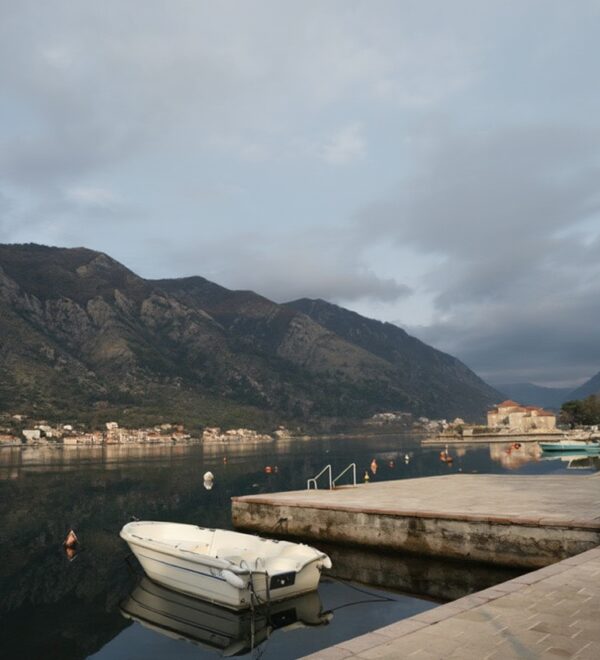
Most people arrive in Kotor having seen photos of it — the triangular old town with its orange rooftops, pressed between the grey cliff face and the still grey water of the bay, the fortress walls zigzagging up the mountain above. The photos are accurate. The scale is the thing that surprises people: the old town is genuinely small.
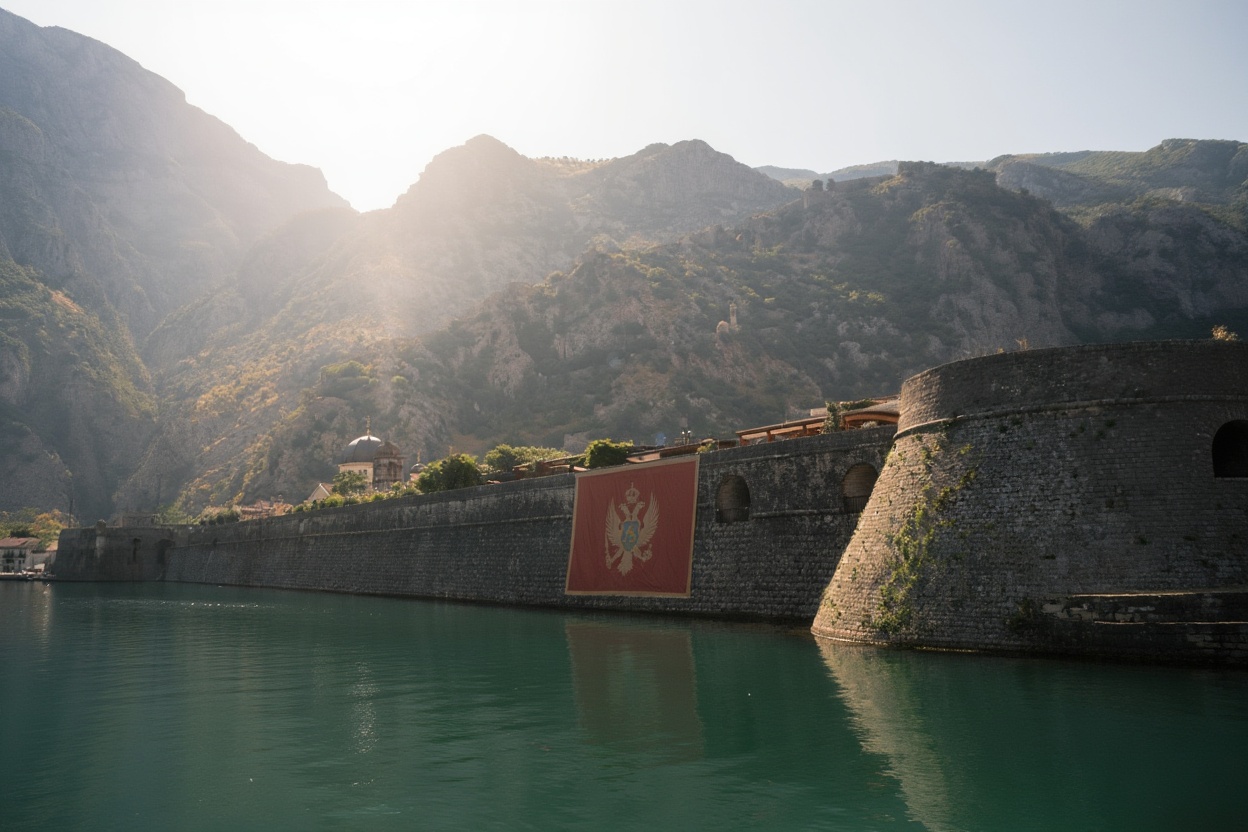
Inside the walls, the old town covers roughly 450 by 260 metres at its widest points. It takes 20 minutes to walk from one end to the other. This is not a criticism — the density is the point. The narrow lanes, the unexpected squares, the churches that appear around corners, the cats on every warm stone surface — all of this happens within an area smaller than many office parks.
The walls themselves are remarkable. They were built over a thousand years, from the 9th century through the period of Venetian rule (1420–1797) and beyond, in response to successive threats from the Ottomans. You can see the different building periods in the different stone — the Venetian sections are more decorative, the older sections more blunt. The total length of the fortification system is approximately 4.5 kilometres. The section you can walk climbs from the old town to St. John’s Fortress at 280 metres above the sea.
Kotor is a UNESCO World Heritage Site. The entire natural and cultural-historical region of Kotor was inscribed in 1979. This matters practically because it affects what can be built and changed — which explains why the old town looks as it does rather than having been converted into a hotel complex.
Getting In: The Gates
The old town has three main gates. All are free to pass through.
The Sea Gate (Vrata od mora): the main entrance, on the waterfront. Built in the 16th century, it has a relief of the Lion of Venice above the arch and a Latin inscription commemorating the Christian defeat of the Ottomans at the Battle of Lepanto in 1571. Most visitors enter here and that’s fine — it’s the most direct route from the parking area and the cruise ship dock.
The River Gate (Vrata od rijeke): the southern entrance, by the Sveti Ivan river. Less busy than the Sea Gate, better for photography in the afternoon light.
The North Gate (Gurdić Gate): the smallest of the three, on the eastern side. Leads into the residential area of the old town. Almost no tourists come through here, which makes it the most interesting to use.
Entry to the old town itself: free. The confusion comes from the fortress climb, which has a ticket. To be clear: walking into the old town through any of the gates costs nothing.
The Fortress Climb: The Main Event
The fortress climb is the best thing in Kotor. Not the best free thing — the best thing, full stop. 1,350 steps from the old town to St. John’s Fortress at 280 metres above sea level, through medieval walls, past a series of churches and viewpoints, ending at a position where the entire Bay of Kotor spreads below you and the Lovćen mountain rises immediately behind.
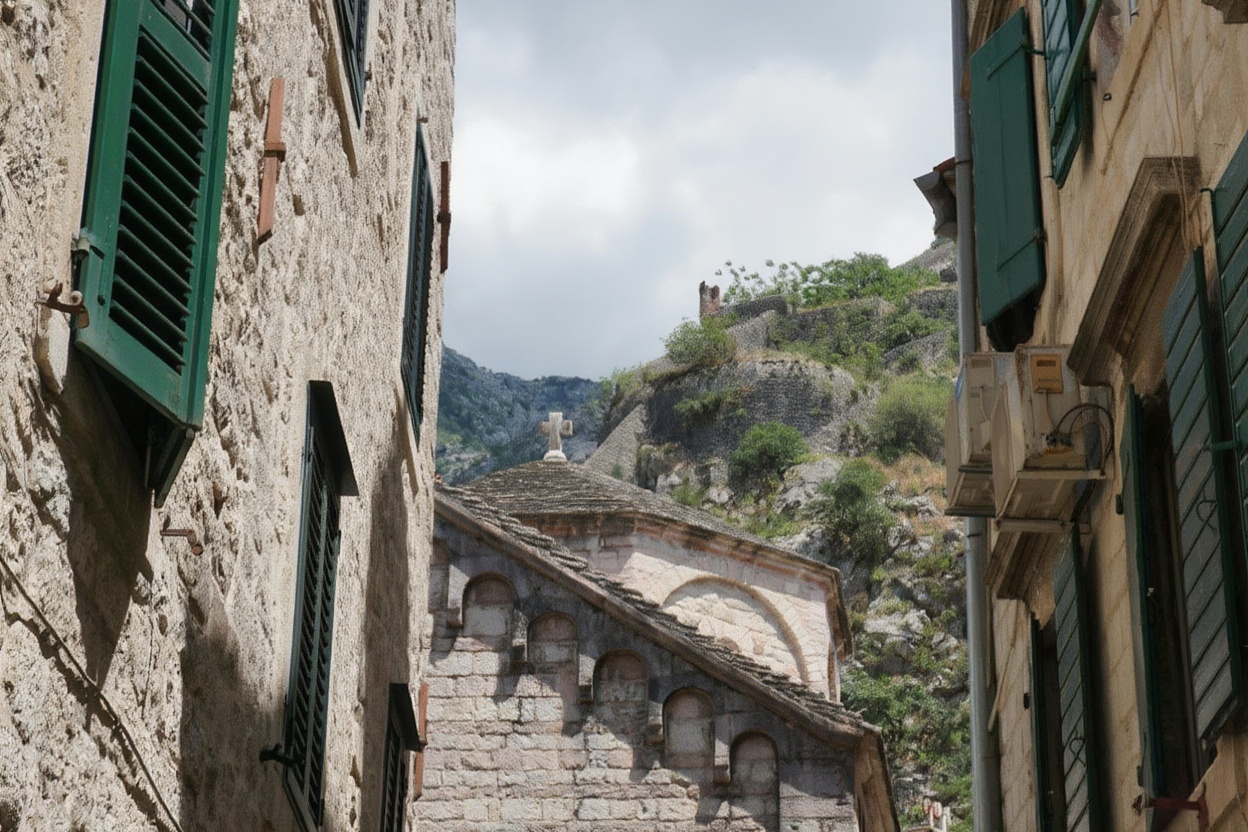
The entrance: a ticket booth on the main wall access route, inside the old town. The entrance fee is €3 per person — not €15, as some older guides say. The higher figure was either outdated information or referred to a guided tour package. The self-guided wall climb is €3, cash accepted.
The route: the main entrance is behind the Cathedral of Saint Tryphon. Follow the signs for “Fortress” or “Fortifikacije.” The path is uneven stone steps the entire way — narrow in sections, with no handrails for significant stretches and drops on the outer edge that focus the mind. Wear shoes with grip. This is not suitable for small children unless you’re very confident about their ability.
Time: allow 45–60 minutes up, 30–40 minutes down. Take it slowly. The steps are irregular and legs tire faster than expected on the descent.
When to go: before 9am or after 4pm. The fortress in the early morning, when the light catches the limestone walls and the bay below is still, is the hour for which people drive from Dubrovnik. The fortress at 11am in July, behind a line of cruise ship tourists, is a different experience. Both lead to the same views, but the difference in the quality of the journey is significant.
What’s at the top: St. John’s Fortress itself is partly ruined — walls and towers without a complete roof structure. The Church of Our Lady of Health (Crkva Gospe od Zdravlja) is halfway up and intact, worth stopping at. The fortress walls are explorable. The views are the thing: 360 degrees of the Bay of Kotor, the Venetian-era town directly below, the Lovćen massif behind, and on a clear day the Adriatic visible in the distance.
•TOM’S PICK
The northwest corner of the fortress walls, facing directly down the Bay of Kotor toward Perast. The bay curves away to the right and the limestone cliffs drop into green water. I’ve brought six different visiting friends here and none of them said anything for the first minute. That’s the correct response.
The Churches and Squares
Kotor Old Town has more medieval churches per square metre than almost anywhere in the western Balkans. Most are small, some are museums, several are still active. Here’s what’s worth your time.
Cathedral of Saint Tryphon (Katedrala Svetog Tripuna): the most significant building in the old town. Built in 1166 (rebuilt after earthquake damage in 1667), dedicated to Kotor’s patron saint. The interior has Romanesque architecture and Byzantine-influenced decoration. The cathedral treasury holds relics, goldwork, and religious art accumulated over centuries of Venetian patronage.
Entry: €2.50 per person. Open daily, typically 9am–7pm in summer, shorter in winter. Worth visiting for the interior and the tower views — you can climb to the top of one of the towers for an additional view over the old town rooflines.
Church of Saint Luke (Crkva Svetog Luke): 12th century, free to enter. One of the oldest buildings in Kotor. The exterior is unassuming; the interior has two altars — one Catholic, one Orthodox — reflecting the mixed history of the town’s religious administration. It was used simultaneously by both communities at different periods of its history. This kind of ecumenical history is unusual and worth knowing about.
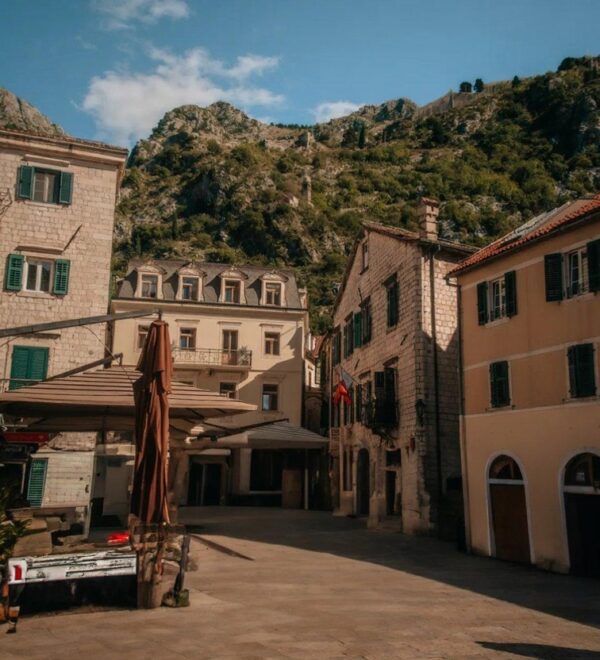
Arms Square (Trg od Oružja): the main square of the old town. The 17th-century Clock Tower dominates one side. The square is where people eat, drink coffee, and sit on the steps. In the early morning, before the tourists arrive, it’s occupied by locals drinking espresso and feeding the cats. In the afternoon in summer, it’s occupied by everyone else.
Saint Nicholas Cathedral (Crkva Svetog Nikole): the Serbian Orthodox cathedral, smaller than Saint Tryphon’s and less visited. 20th century in construction but significant — the Orthodox community in Kotor maintained their faith through the periods of Venetian Catholic dominance, and this church represents that continuity. Free to enter.
The Flour Square (Trg od Brašna): the second main square. Quieter than Arms Square, better for sitting. A small café on the corner has tables directly on the square and charges local prices.
The Cats of Kotor
This sounds like a novelty item in a guide. It isn’t.
Kotor has been associated with cats since the medieval period — sailors brought cats to the port, the cats stayed, and the town adopted them. There are an estimated several hundred cats within the old town walls. They sleep on window sills, on warm stone steps, on café chairs, on the base of the Clock Tower. They are not feral in the aggressive sense — they’re confident and familiar, accustomed to being fed and photographed by visitors.
The Cats Museum of Kotor — a small, eccentric local museum on Rupe Square — celebrates this relationship with artwork, local history, and cat-related souvenirs. It’s charming rather than serious. Entry: €1–2.
The cats are one of the things that makes Kotor feel less like a heritage museum and more like a place where people actually live. The 400 residents coexist with the cats in an arrangement that has clearly been working for a very long time.
The Gradska Pijaca Market
The market near the Sea Gate — outside the walls on the waterfront side — operates every morning and sells local produce: Njeguški prosciutto (the cured ham from the village of Njeguš, in the mountains above Kotor), local olives and olive oil, mountain cheese (sir), honey, vegetables, and the usual souvenir items.
The prosciutto from Njeguš is the specific thing worth buying. The village sits at 900 metres in the hills above Kotor, where the combination of altitude, mountain air, and curing technique produces something that is genuinely distinctive. It’s sold in the market for €20–25/kg, or you can buy a small portion for €3–5. Better value than any supermarket, and the product is better.
The market opens around 7am and winds down by noon. Buy before 10am for the best selection.
Narrow Streets Worth Finding
The old town’s street grid is medieval — which means it doesn’t have a grid. The lanes are narrow enough that in some sections you can touch both walls by spreading your arms. Finding your own route is the correct approach.
Pusti me proći (Let me pass): the narrowest named street in Kotor, barely a shoulder-width in places. Signposted, if you look for it. A local joke about the width.
The streets behind the Cathedral: the residential area of the old town, where people who live here have their washing on lines between windows and children play in the lanes. This is the old town that doesn’t appear in the Instagram photos.
The alley by the River Gate: the quietest corner of the old town. Almost no tourists. A small square with a fountain. The cats sleep here in the afternoon.
Day Trips From Kotor Old Town
Kotor is an excellent base for the Bay of Kotor. These are the day trips worth doing:
Perast (12km, 15–20 minutes): a small Venetian baroque town on the bay with 16 churches and two small islands offshore. The islands — Our Lady of the Rocks and Saint George — are the photograph most people associate with the Bay of Kotor. Our Lady of the Rocks is accessible by boat from the Perast waterfront (€5/person, 5 minutes). The island church is open to visitors; the church interior has a ceiling covered in votive tablets from sailors’ families dating back to the 17th century. Go in the morning.
The Lovćen Drive: the road from Kotor up to Lovćen National Park has 25 hairpin bends in 7 kilometres. It is one of the most spectacular mountain drives in the Balkans, and also the road most people find alarming the first time they drive it. The Mausoleum of Petar II Petrović-Njegoš at the top (1,657m) commands views of the bay, the coastal plain, and on clear days the Adriatic. Entry: €3. The drive takes 45 minutes from Kotor.
The Verige Strait: the narrowest point of the Bay of Kotor, between Lepetane and Kamenari. The car ferry takes 5 minutes and costs €5 per car — it opens up the southern part of the bay without the coastal road. Worth taking if you’re driving to Budva or the coast.
Where to Eat and Drink in Kotor Old Town
The old town has restaurants and cafés at every level of price and quality. The rule of thumb: the closer to the Sea Gate and the main tourist flow, the higher the price for equivalent food.
Local price coffee: the café on the south side of the Flour Square (Trg od Brašna) — not the one facing directly onto the square but the one set slightly back — serves macchiato for €1.20–1.50. This is what locals pay. Cafés directly on Arms Square charge €2.50. Both serve the same coffee.
Food: the old town has no genuine local restaurant scene — the 400 residents mostly cook at home. What exists is entirely tourist-facing. For the best value-to-quality ratio, walk 200 metres out of the Sea Gate to the restaurants on the waterfront road heading north toward Dobrota. The fish is the same as inside the walls; the prices are 20–30% less. The konoba restaurants around the River Gate (south end of old town) are marginally cheaper than those on the main square.
Market food: the best and cheapest eating in the area is at the Gradska Pijaca market before 10am — prosciutto, cheese, bread, olives. A proper market breakfast costs €4–6 and is better than most sit-down options nearby.
The Kotor Confession: What I Got Wrong in My First Week
I arrived in Kotor in February 2022 with the plan of doing the fortress climb on my first afternoon. February is off-season — I was the only person on the path. The light at 3pm in winter is low and sideways, catching the limestone at a flattering angle. I had the entire upper fortress to myself for 40 minutes.
Then I came back in June with friends from Bristol. Same path, 10:30am. We were behind approximately 300 cruise ship passengers. The path narrows to one-person width on several sections. People were stopping for photographs on the same stones where there’s a 100-metre drop on the outer edge. Progress was slow and mostly involved waiting for gaps.
The fortress climb is the best thing in Kotor. It is also, at the wrong time, an exercise in patience rather than an experience. I now tell everyone who visits: 7am or after 4pm, no exceptions. The cruise ships dock around 8–9am and most passengers are bused from the dock to the city walls by 9:30am. The first hour of opening (8am–9am) is already compromised. Before 8am is free and completely empty. After 4pm the ships are back on board and the upper fortress is yours. These are the facts. Plan around them.
When to Visit and What to Avoid
Best time of day: 7–9am. The old town before the cruise ships arrive is one of the genuinely quieter places in the Balkans. The light is good, the cats are active, the market is open, and the fortress can be climbed without a queue. After 6pm is also good — many day visitors leave and the town returns to something resembling its actual scale.
Cruise ship arrivals: check the cruise ship schedule for your dates. Websites tracking Mediterranean cruise itineraries show scheduled calls at Kotor. Multiple ships in one morning means 4,000–8,000 additional visitors between 9am and 4pm. This does not make Kotor inaccessible — it makes the morning rush more intense. Adapt accordingly.
Best months: May, June, September, October. The light is better than July–August, the crowds are thinner, and the temperature is comfortable for the fortress climb without requiring a full water kit.
July–August: Kotor is at its busiest. The old town is genuinely crowded in the afternoons. The fortress is worth climbing but expect company. Accommodation prices are at their highest. If you’re coming in peak season, adjust expectations and work with the timing rather than against it.
- Is Kotor Old Town worth visiting?
- Yes, without qualification. Kotor Old Town is one of the best-preserved medieval walled cities in the Balkans, UNESCO-listed, with a remarkable density of churches, Venetian palaces, and narrow medieval lanes compressed into a genuinely small area. The fortress climb above the town offers some of the best views in the Adriatic region. The main caveat is timing — the cruise ship crowds between 9am and 5pm in July and August are real. Arrive before 9am or after 6pm and the town is a different place.
- How much does it cost to enter Kotor Old Town?
- Entering the old town through the Sea Gate, River Gate, or North Gate is free. The fortress climb costs €3 per person (self-guided, cash accepted). The Cathedral of Saint Tryphon charges €2.50. The Cats Museum is €1–2. Most other churches are free to enter. Budget €10–15 per person for all the paid attractions in the old town, plus whatever you spend at the market and cafés.
- How long does the Kotor fortress climb take?
- Allow 45–60 minutes to reach St. John’s Fortress at the top, and 30–40 minutes for the descent. The route involves 1,350 steps on uneven stone with no handrails in several sections. It’s physically demanding rather than technically difficult — good footwear and a reasonable fitness level are sufficient. The climb is fully manageable for most adults. Avoid attempting it in the midday heat of July and August; go before 9am or in the late afternoon.
- What is the best time to visit Kotor Old Town?
- Before 9am or after 6pm, particularly in July and August. The cruise ship arrivals between 9am and 4–5pm add several thousand visitors to a space that normally houses 400 people. Early morning is the best time — the market is open, the light is good, the cats are active, and the Arms Square is occupied by locals rather than tourists. May, June, September, and October offer the best combination of good weather and manageable crowds.
- How do I get from Kotor Old Town to Perast?
- By car or taxi — about 12km, 15–20 minutes along the coastal road following the bay north. There is a local bus service but it’s infrequent; a car or taxi is more practical for a day trip. From Perast, the boat to Our Lady of the Rocks island (the island church visible from the waterfront) costs €5 per person and takes 5 minutes. Perast is one of the most beautiful small towns in the entire Adriatic region and is undervisited compared to Kotor — worth the detour.
- Are the cats of Kotor real?
- Yes. The cats of Kotor are not a marketing invention. The town has had a cat population for centuries, tracing to the medieval port and the sailors who brought cats from across the Mediterranean. There are several hundred cats within the old town walls, they are familiar rather than feral, and they are fed and looked after by residents and the municipality. The Cats Museum on Rupe Square celebrates this history. The cats sleep on the fortress steps, on café chairs, on the Clock Tower base, and in the shade of every doorway. Finding all of them is an entirely legitimate way to spend time in the old town.